
An industrial set-up in Southeast Asia starts neither with a plot of land nor with a construction quote. It starts with the product, the flows and the way of manufacturing. Subcontract, assemble or produce: the right choice is made before drawing the walls, and early mistakes are paid for long after start-up.
The first choice isn't the country. It's what you really want to make on site
When a European business owner considers producing in Asia, the question often comes too late: "What are we going to do in this factory?" People are already talking about land, floor area and machines, while the industrial model hasn't been defined.
You have to start with the product. An agricultural machine, a metalwork assembly or a welded structure doesn't just break down into parts: it breaks down into operations, skills, materials, inspections and logistics flows. Some parts can be made locally. Others will make more sense to import, especially when they are very specific, already paid off in Europe or tied to know-how that is hard to reproduce immediately. The challenge is to decide what must come into the country, what must be bought locally and what must be processed on site.
This is the real make or buy decision. You have to compare the full cost, not just the hourly rate: materials, transport, customs, inspection, stock, lead times, scrap, rework, tied-up capital and the risk of shortages. A part that is cheaper to buy can become more expensive when it requires three extra weeks of stock or urgent transport.
Three models are then possible: subcontract part of the manufacturing, assemble imported components locally, or gradually produce the whole thing. The right choice depends on the product, the volume, the level of control you want and the ability to secure suppliers. A successful set-up isn't necessarily the one that makes the most things: it's the one that makes things in the right place.
Choosing Thailand for its industrial flows, not just its costs
The choice of country must then be linked to the production model. In Thailand, the Eastern Seaboard, around Chonburi and Rayong, is a particularly attractive environment for industrial projects that need access to ports, suppliers and infrastructure. Being close to Laem Chabang simplifies imports of materials and components, as well as re-exports. In an industrial project, a few hours of transport saved on each delivery add up to a significant difference over the year.
You also have to look at the pool of subcontractors available around the site. For metalwork, machining, electrical or automation work, the question isn't simply "are there suppliers?". You need to know whether they can produce the parts at the expected quality level, in the volumes required, with sufficient inspection capability and consistency. The industrial zone is therefore chosen according to flows, accessible skills, infrastructure, room for expansion and customs constraints. A cheaper plot, far from suppliers and the port, can cost a great deal more to operate.
The legal and customs framework must be studied before the first investment
An industrial set-up isn't just about creating a company and renting a building. You need to determine the right legal structure, the investment conditions, the necessary permits and the regime that applies to imports and exports. Investment promotion schemes can be relevant depending on the nature of the project, the planned activities and the target markets. Industrial zones and certain customs regimes can also significantly change the economics of the project, especially when some components are imported and then re-exported as finished products.
These subjects must be dealt with before the industrial model is fixed. The rules of origin for re-exports to Europe, the required documents, duty regimes and traceability obligations can influence the way you manufacture: an operation carried out locally doesn't automatically mean the product gains the desired origin. The right reflex is to have the industrial, logistics, legal and customs functions work together. A decision based solely on manufacturing cost can be undermined by the cost of importing or by a re-export constraint.
Qualify subcontractors in their workshop, not on their website
Choosing suppliers is one of the most sensitive points of a set-up. A subcontractor can have an impeccable website, photos of modern equipment and an impressive list of capabilities. That isn't enough to guarantee it will be able to make your part.
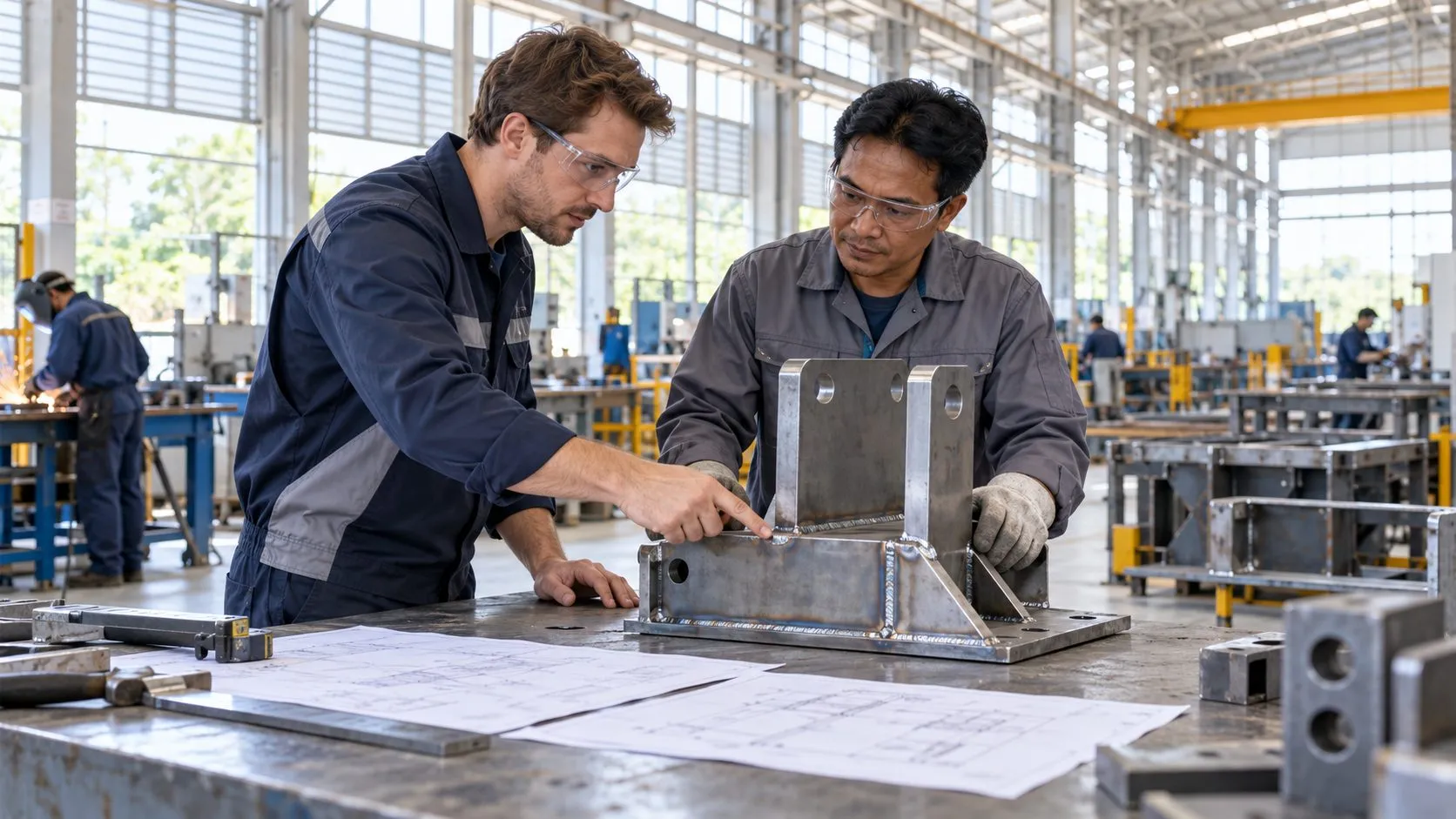
Qualification must be done in its workshop. You need to look at the machines actually available, the condition of the equipment, the work organisation, materials management, inspection resources, traceability and the way the operators work. You also need to understand who actually carries out the operations announced: the company itself or another subcontractor.
A subcontractor is qualified in its workshop, not on its website.
The first part is an essential test. It checks understanding of the drawing, the ability to hold tolerances, weld quality, finish, inspection and the consistency of the process. But qualification doesn't stop at that first delivery: a supplier can succeed with a prototype and run into difficulties as soon as volumes increase. Quality control continues delivery after delivery, with clear criteria and the ability to deal quickly with deviations. The goal isn't to inspect every part forever: it's to gradually build a system of trust based on results.
Design the building around the lines, and the lines around the product
The building must be the result of the industrial process, not its starting point. For metal fabrication, you need to think through the flows of cutting, bending, welding, painting and assembly before determining the floor area required. Material must come in, be processed, inspected, stored if necessary, then go out without unnecessary crossings.
A badly placed welding station creates constant movement. A paint area too far from assembly multiplies handling. Undersized storage blocks circulation. Insufficient truck access complicates deliveries. A building that is too low or too narrow prevents the installation of equipment that was planned from the start.
A badly placed square metre is paid for every day for twenty years.
The cost isn't just construction: it's movement, handling, stock, waiting time and successive adaptations. Possible extensions must also be planned. A factory that runs well soon needs a new line, an extra storage area or a larger assembly space. Designing a building without thinking about how it will evolve often means paying twice.
Equipment must be chosen for the real flow
The choice of machines must not be dictated by purchase price alone. It must be linked to volume, product variety, the expected level of precision and the skills available. A new machine makes sense for a critical or highly automated operation. A second-hand machine can suit simpler operations, provided you check its condition, parts availability, maintenance and compatibility with the rest of the line.
You also have to choose between imported and local equipment. Some will be easier to maintain with a local supplier; others will need technical support from Europe. The real cost includes transport, installation, commissioning, training, spare parts and possible downtime. Maintenance is often underestimated: a machine stopped for lack of a part or a competent technician costs far more than the saving made at purchase. Critical parts, consumables, maintenance procedures and the necessary skills must therefore be planned from the start.
Teams aren't recruited after construction
A factory doesn't run because the machines are installed. It runs because teams know how to use, set up and maintain them and solve problems. Recruitment must therefore start early enough: identify the skills available locally, the positions that need specific training and those for which European support will be needed. Operators, technicians, production managers and quality staff must be part of the project before start-up.
Training isn't just about explaining how to use a machine. It passes on manufacturing standards, inspection methods, safety, maintenance and the logic of the flow. Management differences must also be taken into account: how to give an instruction, report a problem, take initiative or challenge a decision. In the first years, the presence of an expatriate site manager is often decisive. Their role isn't to do everything in place of the teams, but to build the methods, train local managers and gradually hand over control of the factory.
Start-up is prepared before the first day of production
Realistic timelines include the whole project: choice of industrial model, supplier qualification, setting up the company, permits, building design, construction, equipment orders, transport, installation, recruitment, training and trials. The classic mistakes are well known: copying the European factory without taking local flows into account, underestimating logistics, neglecting maintenance, forgetting spare parts, recruiting too late, or thinking that the first part produced means the factory is operational.
Start-up is organised as a ramp-up: equipment acceptance, compliance checks, dry runs, trials with material, first part, quality control, corrections, then a gradual increase in volumes. Each step is validated before moving on to the next.
That's also why a single contact must be able to follow the project from the first drawing to the first part. When the building, the machines, the suppliers and the teams are managed separately, problems move from one contractor to another. When someone keeps the overall view, decisions stay consistent.
A successful industrial set-up in Southeast Asia isn't about reproducing a European factory at lower cost. It's about building a production tool suited to its product, its flows, its suppliers and its teams.
And at ATARE?
Our engineers support industrial projects from the study of the production model through to site start-up: choice of suppliers, building design around the lines, equipment, recruitment and training of teams, with a presence on site in Thailand. Design and set up your factory · Outsourced production and sourcing